No More Room in Hell 2 Skills Guide and Full 1.0 List
Learn how skills unlock, see the current 1.0.3 skill list, choose role-based perks, and understand rerolls, Expert upgrades, and permadeath.
Quick answer
- A Responder can hold ten skills, with the final slots opening at levels 75 and 100.
- Account level expands the skill pool and Expert eligibility; Responder level opens character slots.
- Version 1.0 added three reload skills and removed Averaging, Guts, and Teddy Bear.
- Use Credits to reroll or upgrade skills, and remember that a dead Responder loses that build.
Road to 1.0 | Economy & Progression | No More Room in Hell 2 launch info
See the 1.0 skill pool changes and the progression update that made rerolls cheaper for focused builds.
Continue reading
These related guides answer the next questions around this topic so you can keep moving.
How Skills Work in Version 1.0
Skills are permanent bonuses attached to one living Responder. A new character has a background and one randomly selected starter skill from that profession's pair. Successful extractions raise the Responder's level and open more slots. A fully developed character has ten slots, with the last two opening at levels 75 and 100.
Account level controls a different layer. It expands the skills and Expert versions that can appear when you make character choices. Account progress survives character death, so an experienced account can rebuild with a broader pool even after losing a high-level Responder.
| Progression layer | What it controls |
|---|---|
| Profession | The two possible starter skills for a new Responder |
| Responder level | Skill slots on that individual character |
| Account level | Skills and Expert versions available for choices |
| Credits | Rerolls and eligible Expert upgrades |
Version 1.0 added Handgun Reloading, Rifle Reloading, and Shotgun Reloading. It also removed Averaging, Guts, and Teddy Bear from the pool. Older tier lists that recommend those removed perks describe a pre-1.0 game.
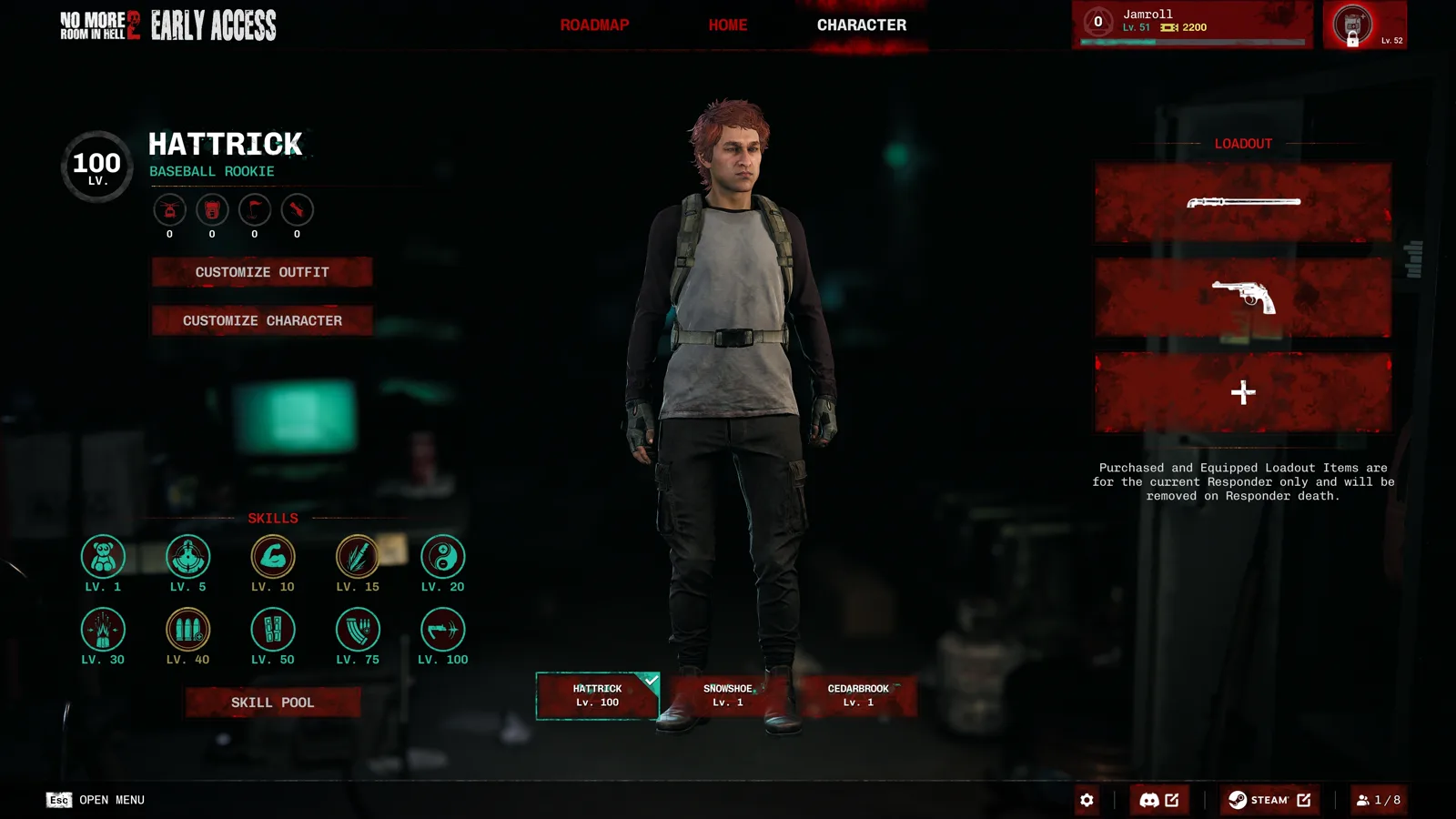
A fully developed Responder has ten skill slots, with the final two opening at levels 75 and 100.
Complete Skill List for 1.0.3
Version 1.0.3 has 47 active skills. The groups below describe their main job, so a skill may still help outside the category where it appears.
Survival and stamina
Acquired Immunity, Adrenaline Rush, Athlete, Deprived, Limbo, Lucky Pathogen, Marathon Runner, Resilience, Sturdy Body, and Thick Skin.
These skills improve health, damage resistance, stamina economy, downed time, or protection from infection and environmental hazards. Athlete, Marathon Runner, Sturdy Body, and Thick Skin are the broadest choices because they help during most matches.
Melee and control
Butcher, Doorbreaker, Foreman, Hard Blow, Headhunter, Heavy Shoves, Hitman, and Rush.
This group covers head or limb damage, one-handed and two-handed attacks, charged-attack stamina, shoves, and interactions with doors or barricades. Match the perk wording to the melee weapon and attack pattern you actually use.
Medical and rescue
Healing Item Stack, Resident Genes, Skilled Medic, and Stayin' Alive.
Skilled Medic improves healing output, while Stayin' Alive accelerates revives. Healing Item Stack reduces the carry burden of medical supplies. Resident Genes adds recovery value to pills and becomes more flexible in its Expert form.
Carry, stealth, and utility
Builder, Caravan, Grenadier, Longer Battery, Mule, Quiet Steps, Scavenger, and Vulture.
These skills change inventory pressure, battery use, movement noise, ammunition yield, or the weight of specific item types. Read the tradeoff on Caravan and Mule before taking the extra capacity, since both exchange one stat for another.
Handguns
Handgun Reloading, Headblown, Steady Hands, and Wicked.
This set covers reload speed, head damage, spread, and limb damage. Headblown rewards careful headshots, while Wicked serves a limb-focused plan.
Rifles and SMGs
Eagle Eye, Hellfire, Locked On, Mohawk, Penetrating Shot, Rifle Reloading, Steady Shot, Steel Chamber, and Winged.
Rifle Reloading applies to rifles and SMGs. The rest specialize in recoil, hip-fire spread, range, penetration, or damage for particular firearm families. Check the exact weapon class before spending an upgrade.
Shotguns
Icarus, Overkill, Shotgun Reloading, and Tight Shot.
Icarus extends effective range, Overkill adds pellet output, Shotgun Reloading improves the reload cycle, and Tight Shot narrows spread. They work together well, though a ten-slot build rarely needs every shotgun bonus.
Best Skills by Responder Role
There is no universal tier list because the useful choice depends on the weapon, inventory, team role, and risks the Responder is built to handle. Start with one job, then spend most slots reinforcing it.
General survival
Athlete and Marathon Runner protect the stamina needed to reposition or escape. Sturdy Body and Thick Skin offer straightforward durability. Skilled Medic adds value when the character regularly carries healing supplies. Pick two or three of these as a foundation, then reserve room for the chosen weapon.
Handgun specialist
Handgun Reloading shortens downtime, Steady Hands improves consistency, and Headblown rewards accurate headshots. Add Wicked only when limb damage is an intentional part of the plan. This leaves several slots for stamina, health, and carrying capacity.
Rifle or SMG specialist
Rifle Reloading is the shared reload option for both families. Rifle users can pair it with Steady Shot and the damage or penetration skill that matches their weapon. SMG users can favor Locked On for recoil and Winged for range. Hellfire belongs in a rifle hip-fire build, so it has less value when the player always aims.
Shotgun specialist
Shotgun Reloading solves the weapon family's most visible downtime. Tight Shot improves consistency, while Icarus helps at range and Overkill leans into pellet output. Combine the reload skill with one handling or damage choice before spending every open slot on the same weapon.
Melee specialist
Melee builds need stamina before extra damage. Athlete, Marathon Runner, or Rush can keep attacks and movement available. Add Headhunter or Hitman for a one-handed plan, and Hard Blow or Rush for charged two-handed attacks. Butcher fits a deliberate limb-damage approach.
Medic and rescuer
Skilled Medic and Stayin' Alive form the direct support core. Healing Item Stack makes the supply burden easier to manage. Resident Genes can add personal infection recovery, while stamina and durability skills help the medic reach a downed teammate alive.
A strong Responder spends each slot on one job and treats every off-plan perk as a reroll question. Broad survival skills fill gaps; weapon and support skills define the build.
Rerolls, Expert Upgrades, and Permadeath
Credits let you reroll offered skills or upgrade an owned skill from its base version to Expert. The account must first meet that skill's Expert unlock requirement. A low-level account therefore sees fewer useful options even when the Responder has an open slot.
Reroll when a choice does not support the planned weapon or role. Upgrade when the Expert effect improves a skill the build already uses every match. Check the current in-game cost before committing Credits because economy values can change between patches.
Permadeath makes this investment temporary at the character level. If the Responder dies, that character's levels, skill build, and loadout are lost. Account progress remains, so unlocked options can appear on future Responders. Keep enough Credits and at least one backup character to make recovery less painful.